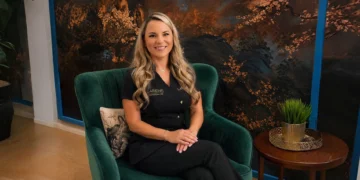
















Farah Hussain’s clinic is busy again. Cardiff on weekdays. Bristol every other Saturday.
That sentence would have sounded impossible eighteen months ago.
This isn’t really where the story starts, though. It’s closer to where it nearly ended.
The Trust That Collapsed Overnight, and Wasn’t Her Fault
A string of national news stories broke that year, one after another, about unqualified practitioners causing serious harm. Untrained injectors. Unregulated clinics. Patients left with real damage.
None of it involved Farah. None of it involved anyone she’d ever worked with.
It didn’t matter. The public didn’t sort qualified from unqualified. They just stopped trusting the entire industry, all at once, and Farah’s diary emptied out along with everyone else’s.
Cancellations came in for weeks. Not because anyone doubted her personally. Because the fear was aimed at the whole profession, and she happened to be standing inside it.
Twelve Years of Training Nobody Was Asking About Anymore
Farah had spent over a decade building genuine credentials. Clinical training first. Then years of advanced qualifications most people outside the industry never think to check for.
Before the news cycle hit, that background had been the quiet foundation everything else stood on. Clients assumed it, mostly, and moved on to talking about results.
Now nobody was assuming anything. Every prospective client seemed to be picturing the worst version of the industry, and Farah had no easy way to prove, from the outside, that she wasn’t part of it.
She started wondering, seriously, whether the damage would simply outlast her business.
The Message That Arrived on a Tuesday Night
A woman messaged Farah’s clinic that week, clearly nervous, asking questions most clients had never bothered asking before. Qualifications. Insurance. What exactly Farah’s training actually covered.
Farah answered every question in detail, expecting the woman to disappear afterward the way several others had.
Instead, she got a reply that stayed with her far longer than the questions had.
I nearly didn’t message anyone at all, after everything in the news. I only messaged you because you actually answer these questions properly, and nobody else seems to bother.
Farah read that message twice. She’d been so focused on the clients she was losing to fear, she’d never really noticed what was quietly bringing the remaining ones to her instead.
What She Started Doing Differently
Farah stopped assuming her credentials spoke for themselves. Clearly, for a while, they hadn’t been speaking loudly enough.
She started answering the exact questions that nervous message had asked, upfront, before anyone even had to ask them. Training. Insurance. What a proper consultation actually involved, step by step, before any treatment was ever discussed.
It felt strange at first, explaining things she’d once assumed were obvious. But the nervous messages kept arriving, and more of them turned into actual bookings.
How the Diary Filled Back Up
The news stories eventually faded, the way news stories do. But by then, something had shifted in how Farah ran her clinic, and it didn’t fade back with the headlines.
Cardiff filled up first. Bristol followed a few months later, largely from people who’d read the same detailed answers online before ever messaging her directly.
Farah didn’t win back trust by waiting for the industry’s reputation to recover on its own. She won it back by being the one practitioner in the room actually willing to answer the question nobody wanted to ask out loud.
Where This Actually Started
It’s worth going back further, to why Farah trained in this field at all, over a decade ago.
She’d watched a family member go through a difficult recovery after cosmetic surgery abroad, handled badly, by someone under-qualified. She’d promised herself, young and a little naive about it, that she’d become the kind of practitioner people could actually trust with something that mattered to them.
For a while last year, it looked like an entire industry’s worst practitioners might undo that promise for her, through no fault of her own. They didn’t, in the end. Mostly because she went right back to the reason she’d started, and simply got louder about it.
The Part Worth Sitting With
Here’s what makes Farah’s version of this story different from a simple comeback tale.
She never did anything wrong. Nothing about her practice changed because of a mistake she’d made. The entire crisis belonged to other people, and yet she was the one who had to answer for it, over and over, to strangers who had every reasonable right to be cautious.
That’s a strange position to be in professionally. Blameless, and still fully responsible for rebuilding trust that someone else broke. Most industries have a version of this moment eventually, where a few bad actors damage everyone’s credibility at once, fairly or not.
The instinct in that moment is usually to get defensive, or to wait quietly for public memory to move on. Farah did neither. She got specific instead, answering the exact fears people had, one honest message at a time, until the fear had somewhere real to go.
Has your industry ever taken a reputational hit because of people who had nothing to do with you personally?